Southwest Kansas farm is a testament to couple’s smart management – JL Farms
When a young couple fresh out of college with degrees in animal sciences arrived in southwest Kansas and started helping out on a wheat operation, they did not plan to build a career together as wheat and crop farmers.
More than 30 years later, JL Farms continues to thrive as a labor of love for owners Jess and Laryce Schwieterman. The couple met at Kansas State University and followed opportunities to eventually put down roots on acreage north of Syracuse, Kansas, less than 20 miles east of the Colorado border and close to where Jess grew up.
“I got started working for a neighboring farmer that had about 3,000 acres and he was going to retire in a year or two,” said Jess Schwieterman. “By ’98, he had turned those 3,000 acres over to us, and it has built from there.”
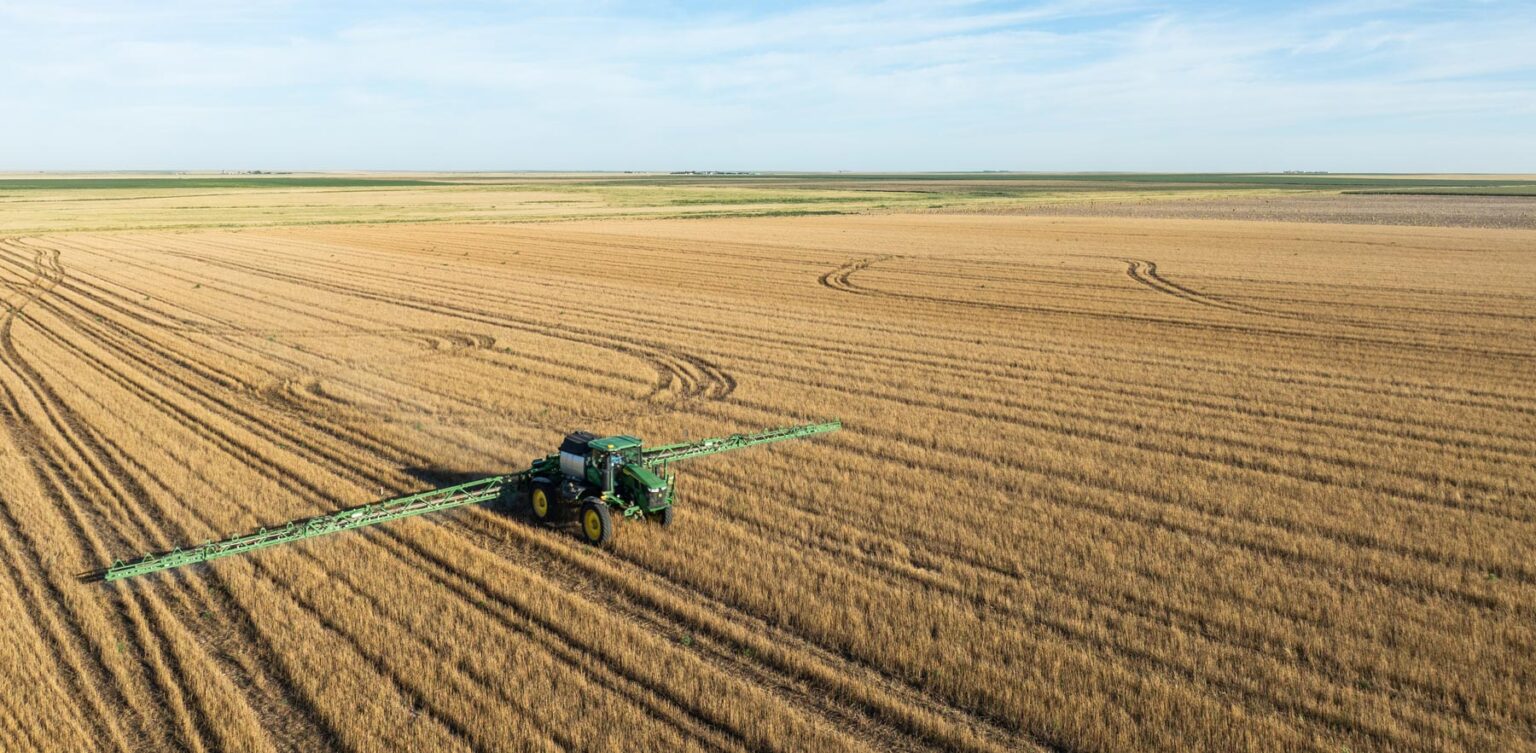
Today, the Schwietermans grow wheat, corn, grain sorghum, and sometimes sunflower on about 13,000 acres in the wide plains and open skies of southwest Kansas.
Here in the rain shadow of the Colorado Rockies, rain and snowfall are fairly limited with an average 16-17 inches of precipitation per year. The region’s semi-arid climate and weather patterns can present challenges for farmers, especially in years with less rainfall than normal.
“Dryland farming can be interesting,” said Laryce. “It can be really dry, and this year happens to be a really a wet year — more than typical. Things are looking really good around here at this point. We tend to think out in this country that the only problem that we have is not enough moisture.”
To make the most of the water that falls on their land, JL Farms uses conservation practices like no-till farming, where soil is left undisturbed to manage crop and plant residue on the surface year-round. The couple says this practice can slow evaporation, reduce soil erosion, and produce healthier soil conditions for wheat and row crops.
By growing cover crops and limiting soil disturbance, JL Farms has been able to boost the land’s fertility and water-storage capacity while reducing some of the inputs required to grow crops.
“I was just listening to a deal the other night on YouTube where they had done no-till for many years and they were showing the difference in the soil when you put it in water, and how the soil that had been tilled was just falling apart,” said Laryce. “That means water will not penetrate into the ground. Out here, you have to conserve every single drop that you get.”
Sharing crop data and selling seeds
Over the years, JL Farms has found success growing grains that are hardy and drought resistant, like the Hard Red Winter wheat that is popular across the region. The Schwieterman have shared their insights with neighbors, some of whom have taken to buying drought- and disease-resistant strains from the couple.
“You like to drive by your own fields and say, ‘Well, that looks good,’ but nothing is more pleasing than driving by a neighbor’s field that looks good,” said Laryce. “You want to see them succeed and you want to see the neighbors succeed, not just yourself. We try to educate the neighborhood about planting more resistant varieties, and our wheat seed business has just grown from there.”
JL Farms expanded into growing seed wheat in 2007 with Danby, a hard white winter wheat variety. The couple’s seed offerings now include white and red varieties, all of which are resistant to wheat streak mosaic and bred to tolerate the region’s dry conditions.
Farming traditions are ‘in our blood’
Jess and Laryce have been successfully farming on this land for more than three decades while raising their daughter Avery. In 2021, the couple was named to the class of Kansas Master Farmers and Farm Homemakers for their conservation efforts and smart management of the farm, including years of data collection on crop varieties and yield.
Laryce said that growing up in rural Kansas, immersed in the world of farming, gave her a deep appreciation for the value of agriculture from a young age.
“I don’t know what else we would do,” said Laryce. “I grew up on the farm and he grew up on the farm, and I guess it’s in our blood, that’s for sure. We don’t necessarily have anyone at this point to pass on the farm to, but it is important that we have something to pass on to the next generation.”
Jess said the best part of farming is when the decisions he and his wife made months in advance prove to be the right ones, when it all comes together and the couple is out harvesting an excellent crop of wheat in the summer.
“We enjoy what we do, and we love to do it because it’s a challenge,” said Jess. “My wife and I both had this opportunity to farm. And so that’s where life took us. We love to do it from a challenge perspective and to see how good we can grow, what we can grow, when we can grow it, and how we can best take on each new opportunity as it comes.”